
Burnsville City Directory Shelves
Burnsville has a documented telephone-book trail rather than a verified, complete run of conventional printed directories. The Minnesota Historical Society finding aid identifies Burnsville telephone books for 1964, 1966 through 2009, a yellow-pages-only 2010 volume, and regular plus yellow-pages entries for 2011. It also flags duplicates and yellow-pages-only volumes. The Dakota County Historical Society holds telephone books and other directories among its broader local-history materials, but the research did not locate a complete Burnsville year list there. Use the finding aid to choose a volume before treating a listed result as a full annual record.
| Collection | Years documented | Holding route | Access method |
|---|---|---|---|
| Burnsville telephone books | 1964; 1966-2009 | Minnesota Historical Society finding aid | Use the finding aid for the physical collection |
| Burnsville yellow-pages volumes | 2010; 2011 also has regular entries | Minnesota Historical Society finding aid | Check volume type before relying on it |
| South Burnsville telephone books | 1983-1996 | Minnesota Historical Society finding aid | Search as a separate classification |
| Yearbooks and local publications | Yearbooks generally 1960-2009 | Burnsville Historical Society | Digitized collection with gaps and processing notes |
There is no verified Burnsville publisher run, reverse-directory run, or complete directory chronology in the research. For Burnsville research, the right notation is the volume, classification, and year actually checked. That makes a Burnsville search reproducible when a shelf has gaps, an issue was not scanned, or a name appears only in a business section.
Burnsville Telephone Directory Years
The Minnesota Historical Society Dakota County telephone-directory finding aid is the clearest place to begin this Burnsville historical search. It covers approximately 1,237 volumes and 226 microfiche across Dakota County, then identifies the Burnsville entries within that larger set. Record the volume year, the Burnsville or South Burnsville classification, the page or section, and whether the listing sits in a personal or business portion. A printed listing can be a solid lead, but it is not a complete account of everyone connected with an address.
The finding aid also shows why a simple name search can miss Burnsville evidence. A Burnsville volume may be duplicated, limited to yellow pages, or classified separately from the modern city name. Use the exact shelf or finding-aid citation if the page is physical. For a missing person, write down “not found in the searched volume and classification” rather than making a broader claim about Burnsville residency.
The Minnesota Historical Society finding aid displays the Dakota County telephone-directory holdings used to locate the Burnsville volumes.
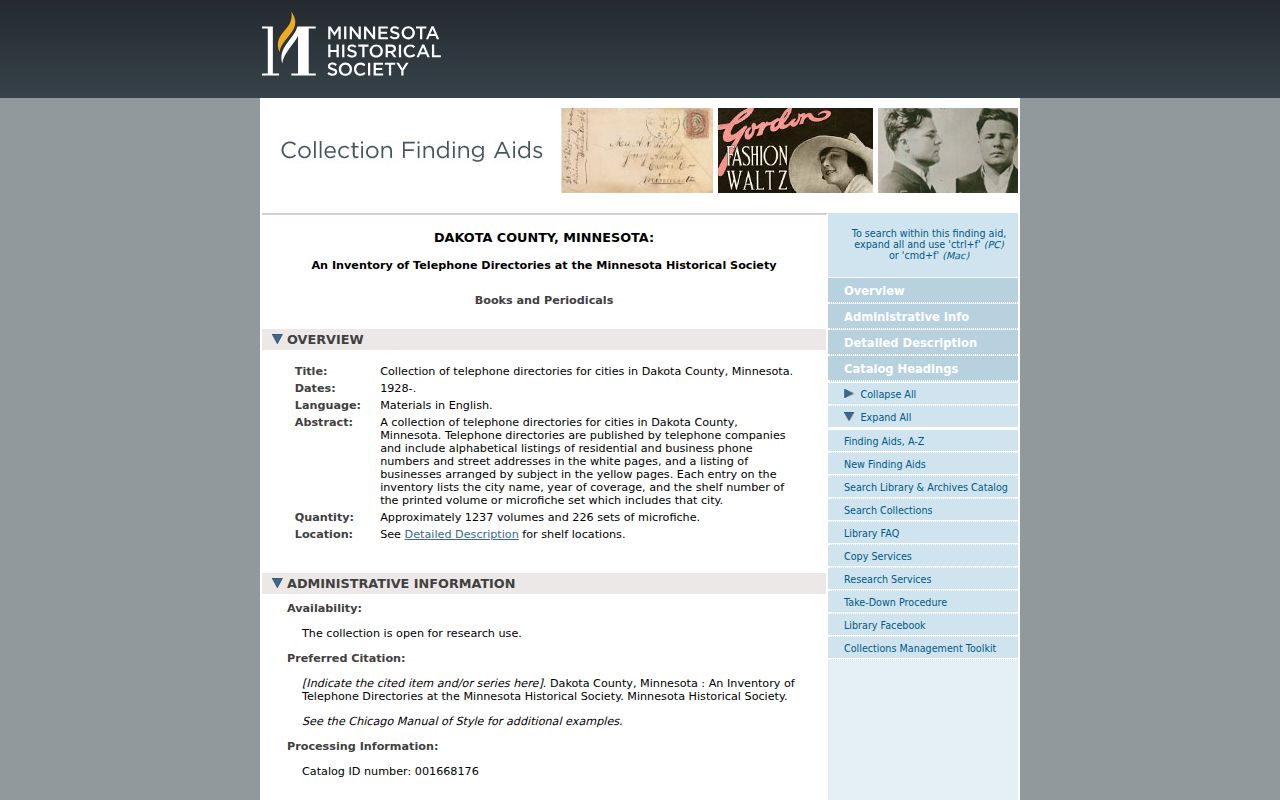
Its year and classification detail gives a Burnsville directory search a precise starting shelf instead of an assumed publication run.
Burnsville City Directory Index Labels
“South Burnsville” is a key Burnsville directory label, not evidence of a separate incorporated place. The Minnesota Historical Society finding aid classifies Burnsville telephone books under that label for 1983 through 1996. A surname found under one label may be overlooked when only the other is searched. This is a local indexing quirk worth placing on every research log beside the year and source type.
Older records can also use township or neighboring-place language. Burnsville was founded in 1858, incorporated in 1964, and later became a city in 1974. Minnesota Historical Society Municipal Board material includes Burnsville incorporation and boundary files dated 1959 through 1973. Those administrative changes help explain why a historical Burnsville directory trail may not use a current city label. Preserve the wording in the source, then compare it with a street, town, or family connection.
- 1858: Burnsville was founded, creating an early historical point for township-era research.
- 1959-1973: Municipal Board records document incorporation and boundary-file activity.
- 1964: Burnsville incorporated, marking the village transition in city history material.
- 1974: Burnsville became a city, a later label that may differ from older source wording.
Note: A directory label identifies how a volume was filed, not the legal jurisdiction or a verified address for every listed person.
Reading Burnsville City Directory Evidence
A Burnsville directory entry should be transcribed as printed before it is interpreted. Minnesota Historical Society notes that directory entries commonly center on a household head. Minors may not appear, and women are more likely to have their own listing when they maintain one. The telephone-directory inventory for Burnsville calls for the printed name, address or telephone fields when visible, the volume year, and personal versus business classification. That is enough to build a careful Burnsville lead without adding unsupported relationships, an occupation, or an ownership claim.
| Printed name | Copy the name and spelling shown in the volume. |
|---|---|
| Volume context | Record the year and whether it was filed as Burnsville or South Burnsville. |
| Address or telephone field | Keep the field only when it is visible in the entry. |
| Section type | Mark whether the item is in a personal or business section. |
| Shelf citation | Save the finding-aid or call-number route for a physical page. |
- Criss-cross directory
- A directory arranged by street or address rather than by name. No complete Burnsville run was verified in the research.
- Householder convention
- A listing style centered on a household head, which can leave other household members out.
- Abbreviation key
- The volume legend that defines its own shortened labels. Preserve it when a directory uses one.
A Burnsville listing is not proof of continuous residence, current contact information, or every household member. It is strongest when another dated record agrees on a town, street, age, spouse or parent, or other independent detail.
Trace Burnsville City Directory Households
Use a Burnsville directory trail as a sequence of dated snapshots. Start with the earliest likely telephone-book volume, then move forward or back one available volume at a time. DCHS census searches provide an independent Burnsville household layer. Its 1920 result inventory includes relationship, age, birthplace, occupation, address, and town, while its 1900 inventory includes relationship, children, marriage duration, birthplace, and naturalization information. The fields differ by census year, so preserve the year and transcription label rather than merging them into one undated profile.
- Choose the first Burnsville or South Burnsville volume that matches the surname and likely time period.
- Log the printed spelling, volume year, classification, page or section, and any visible address or telephone field.
- Check the next available volume for the same name, alternate spelling, or changed classification.
- Pair the dated listing with a DCHS census, cemetery, church, obituary, or newspaper result that supplies an independent relationship or town detail.
- Keep a gap log for missing volumes, unlisted numbers, scan limits, and entries that appear only in yellow pages.
The Dakota County Historical Society search includes more than 500,000 church, cemetery, and census records. Search Burnsville, historical Burnsville township variants, and neighboring places when a directory entry does not align with the later city name. The historical shelf gives a backward trail; modern address-keyed research belongs on the Burnsville street directory page.
Burnsville Historical Collection Routes
The Dakota County Historical Society Lawshe Memorial Museum is the county-level bridge between a Burnsville telephone listing and other local records. Its research library includes newspaper microfilm back to the 1850s, census material from 1849 through 1940, cemetery and obituary records, naturalization and Catholic church records, city and township files, plat maps with ownership from 1879 forward, oral histories, and photographs. For a Burnsville inquiry, research assistance is free for members; the society suggests $15 per half hour for nonmembers, and an appointment is helpful.
Use the DCHS searchable records by surname and collection type, then move to a Burnsville newspaper issue, obituary file, or cemetery record when a result supplies a useful date. A result is an index or transcription lead, not the final proof. DCHS advises testing modern Burnsville terms alongside township variants and nearby places, which is especially important when a historical directory uses a different label.
Note: Photograph, oral-history, and microfilm material can carry restrictions or reproduction rules, so ask DCHS about the specific item before copying it.
Burnsville Yearbook Collection Gaps
The Burnsville Historical Society yearbook collection adds school-age context to a Burnsville historical search. Burnsville High yearbooks are generally digitized for 1960 through 2009, but the Burnsville collection reports gaps and processing status. A 1994 fire affected surviving records. Names, organizations, class activities, and address-adjacent context may appear, yet a yearbook is school-centered rather than a resident roll.
Use a Burnsville yearbook to test a date, school connection, or spelling suggested by a telephone listing. Record the edition, year, page, and scan status. The Historical Society also identifies the 1976 Blue Book and 2000 Red Book quick-reference publications, while reporting continuing conversion of editions back to 1975 and of Burnsville Current material. Treat every scan as an evolving collection and cite the exact item used.
The Burnsville Historical Society yearbook collection shows the local school-year archive and its processing notes.
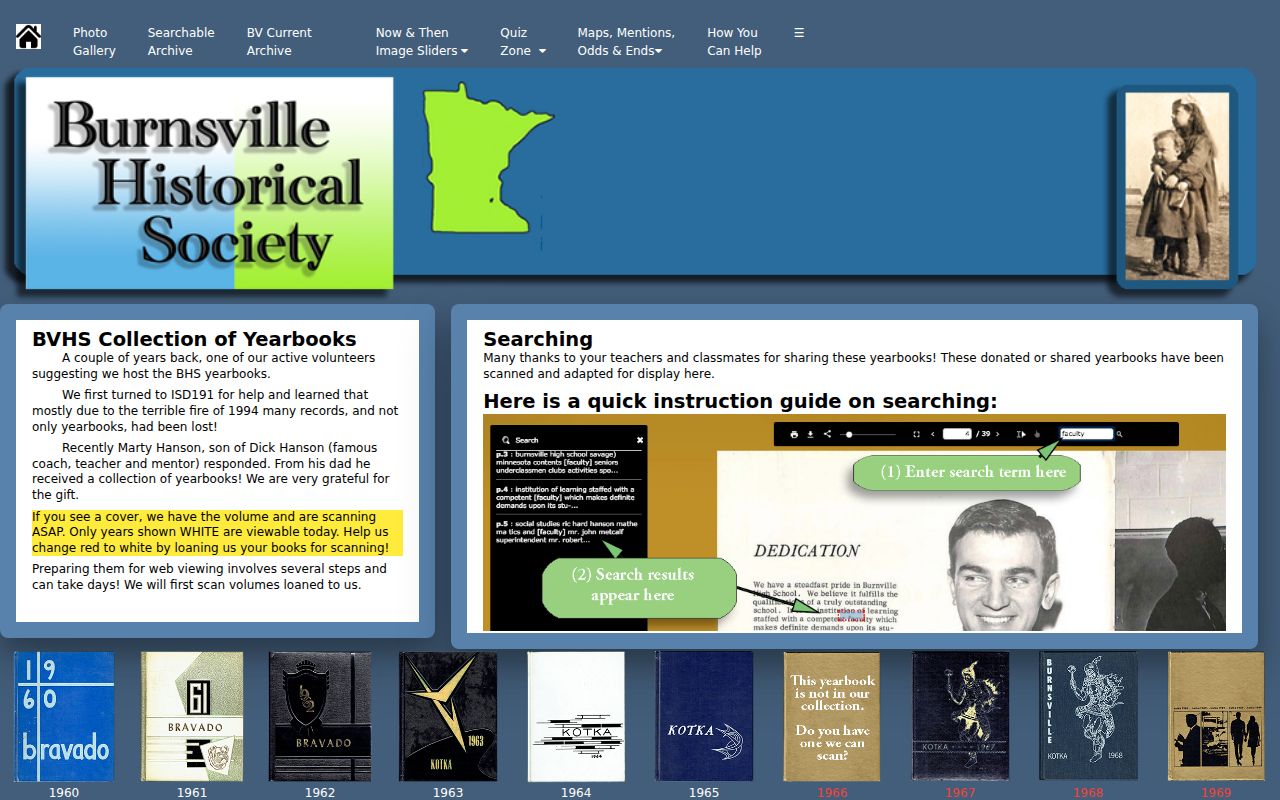
The image underscores why an available Burnsville yearbook is useful context but cannot fill every gap in the historical collection record.
Burnsville City Directory Staff Search
The Minnesota Historical Society city-directory search request offers a practical option when the needed years are known but a visit is not possible. Staff can search one person or business in up to five years. The Burnsville request asks whether to search city directories, telephone books, or both, then requests the name, city or town, years, and added information. Listed prices are $10 for city directories, $10 for telephone books, and $20 for both, with scanning and email included.
Processing is generally three to four weeks and can take as long as 12 weeks. The listed price includes a $5 nonrefundable processing amount. Give the staff a Burnsville alternate spelling and the Burnsville or South Burnsville label when appropriate. For broader genealogy and newspaper work, the Gale Family Library has city directories, telephone books, maps, photographs, newspapers, and local-history reference services.
Burnsville City Directory Limits
Printed Burnsville directories are useful because they preserve a date and a published listing, not because they settle every identity question. An absence can reflect an unlisted number, a business-only page, a missed volume, a spelling variation, a move during the publication interval, a scan gap, or the South Burnsville classification. The research did not verify a full Burnsville reverse or criss-cross directory run, so a Burnsville address cannot be treated as exhaustively searched without stating the specific collection and date range.
Keep historical Burnsville listings separate from current residence. A directory entry may identify a household head, while a census result may add relationships and a newspaper may provide a dated event. Compare the record roles and dates before drawing a conclusion. Use these records for lawful personal, family-history, estate, or community research, and never use a historical listing to harass another person.